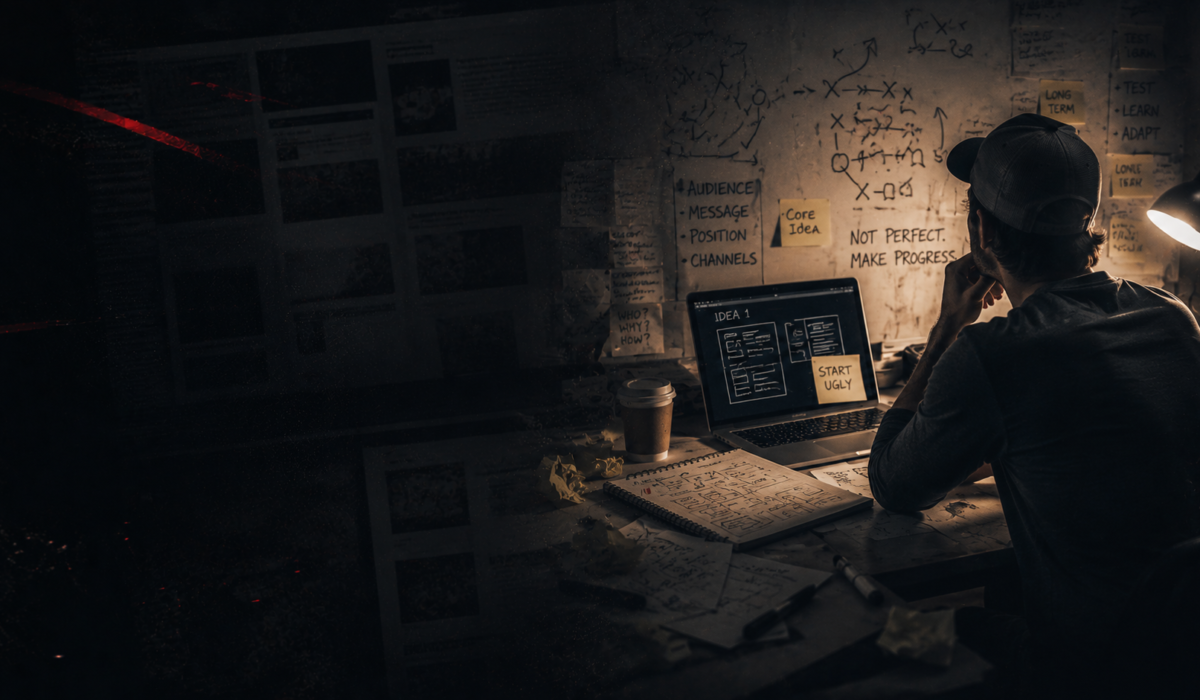
Most people do not want to show the ugly first version.
They want the clean version. The polished version. The version with the perfect design, perfect data, perfect workflow, perfect explanation, and no obvious holes for people to poke at.
That sounds good, but it is usually not how anything useful gets built.
The ugly first version is where the advantage is.
It is the first report that finally answers the question people keep asking. It is the first webpage that makes the old one look outdated. It is the first version of a process that removes three extra emails, two spreadsheets, and a follow-up meeting nobody wanted to have in the first place.
It may not be pretty.
But it exists.
And existing beats theoretical almost every time.
That is the part people forget. A rough version gives people something to react to. A concept gives people something to talk about. There is a big difference.
A concept can sound great in a meeting. Everyone can nod. Everyone can agree there is probably a better way. Someone can say, “We should look into that.” Someone else can say, “Let’s circle back.” Then the meeting ends, everyone goes back to their day, and the same broken process keeps limping along.
But when you build even a rough version, the conversation changes.
Now people can see it. They can click through it. They can argue with it. They can point to what is missing. They can say, “This part works,” or “That part needs to change,” or “Could it also show this?”
That is progress.
A bad first version can become a better second version. A perfect idea that never gets built is just vapor.
I think about this when I look at old promotions, old reports, old websites, old workflows, and all the little business habits that stick around because they are familiar. Not because they are great. Not because they are efficient. Just because nobody has stopped long enough to ask, “Why are we still doing it this way?”
Take something as simple as a promotional scratch-off.
For a long time, that kind of promotion made sense. You print the cards. You ship them out. The customer scratches and wins. It is simple. It is physical. It feels familiar. There is nothing wrong with that on the surface.
But when you start looking closer, you see the friction.
You have printing costs. Shipping costs. Timing issues. Inventory concerns. Manual tracking. Limited visibility. You do not really know what is happening in real time. You do not know who engaged, when they engaged, where they engaged, or how the promotion is performing until after the fact, assuming the information gets captured cleanly at all.
That does not mean the old way was bad.
It just means the old way may have reached its ceiling.
So the better question becomes: what would this look like if we built it today?
Would we still print cards and hope everything gets tracked correctly? Or would we create a digital version? Could the customer scan a QR code? Could the experience happen on a phone? Could we track participation by location? Could we know which markets engaged? Could we see winners, claims, timing, performance, and follow-up opportunities in one place?
That is how the ugly first version starts.
Not as some massive polished rollout. Not as a perfect enterprise platform. It starts with a better question and a rough build.
What if this was digital?
What if this was trackable?
What if this was easier for the customer?
What if this gave the business better information?
That first version might be clunky. The design might need work. The flow might not be perfect. The dashboard might be basic. But suddenly the idea is not theoretical anymore. It is something real. Something people can test. Something that can improve.
That is the power of building early.
The same thing happens with reporting.
A lot of companies have reports that technically exist but do not actually drive decisions. They get sent out every month. They have rows, columns, tabs, charts, and maybe even a few colors. But they do not answer the real question. They do not show the opportunity clearly. They do not tell anyone what to do next.
So people create workarounds.
One person builds their own side spreadsheet. Another person keeps a separate tracker. Someone else manually pulls numbers before every meeting. The team starts relying on tribal knowledge instead of a clean operating system.
Then eventually, the workaround becomes the process.
That is dangerous because it feels normal after a while. Everyone gets used to the extra steps. Everyone learns who to ask. Everyone knows where the “real file” lives. Everyone knows the report is not quite right, but they keep using it because it is what exists.
That is exactly where someone needs to build the ugly first version.
Not because they have all the answers.
Because they are close enough to the problem to see what is missing.
Maybe the first version is just a cleaner report. Maybe it is a better dashboard. Maybe it is a simple tool that pulls the right information into one place. Maybe it only solves 30 percent of the problem at first.
Good.
That is 30 percent more than another conversation about the problem.
People underestimate how much momentum comes from having something visible. Once the first version exists, the business can respond. Users can give feedback. Leaders can see potential. The builder can refine the logic, clean up the layout, add better filters, improve the flow, and make it stronger.
The ugly first version is not the final product.
It is the proof of movement.
And movement matters.
I have seen plenty of people wait for the perfect moment. They wait for approval. They wait for budget. They wait for a vendor. They wait for someone higher up to say it is okay. They wait until the timing is cleaner, the requirements are clearer, the data is better, the resources are available, and the calendar opens up.
Sometimes that is real.
But a lot of times, it is just drag.
The truth is, there may never be a perfect moment. The calendar may never calm down. The data may never be flawless. The process may never be fully documented. The budget may never magically appear. The people who need the solution may not even know how to ask for it yet.
That is why the person willing to build the rough version has an advantage.
They are not waiting for perfect conditions. They are creating forward motion.
That does not mean being reckless. It does not mean launching something half-baked and pretending it is finished. It does not mean skipping alignment, ignoring risk, or building in a vacuum.
It means understanding that clarity often comes after the first version exists.
You learn by building. You learn by testing. You learn by putting the idea in front of real people and watching where they get confused, where they light up, and where they ask for more.
That feedback is gold.
It tells you what matters. It tells you what does not. It shows you whether the thing has merit or whether it was just a decent idea in your head.
That is another reason the ugly first version wins. It forces honesty.
Ideas can hide when they stay in conversation mode. They can sound smarter than they are. But when you build them, even roughly, they have to stand up. They have to function. They have to solve something. They have to earn attention.
That is a good thing.
Because if the first version has no merit, you find out quickly. You adjust, rebuild, or move on. But if it does have merit, even just a little, you now have something to work with.
That is where real innovation happens. Not always in massive breakthroughs. Sometimes it is in taking a tired process and making it easier. Taking a printed promotion and making it digital. Taking a monthly report and making it actionable. Taking scattered information and turning it into direction.
That may not sound flashy, but it matters.
Businesses do not only improve through giant transformations. They improve when someone notices friction and decides not to accept it as normal.
That is the mindset.
If the report does not answer the question, rebuild it.
If the process creates confusion, simplify it.
If the promotion is outdated, modernize it.
If people keep guessing, give them a tool.
If the idea keeps coming back, stop talking around it and make a first version.
It will probably be ugly.
Build it anyway.
Because the ugly first version is where momentum starts. It is where the conversation changes. It is where the idea becomes real. It is where people stop debating whether something could work and start helping make it better.
The polished version gets the applause.
But the ugly first version gets the business moving.