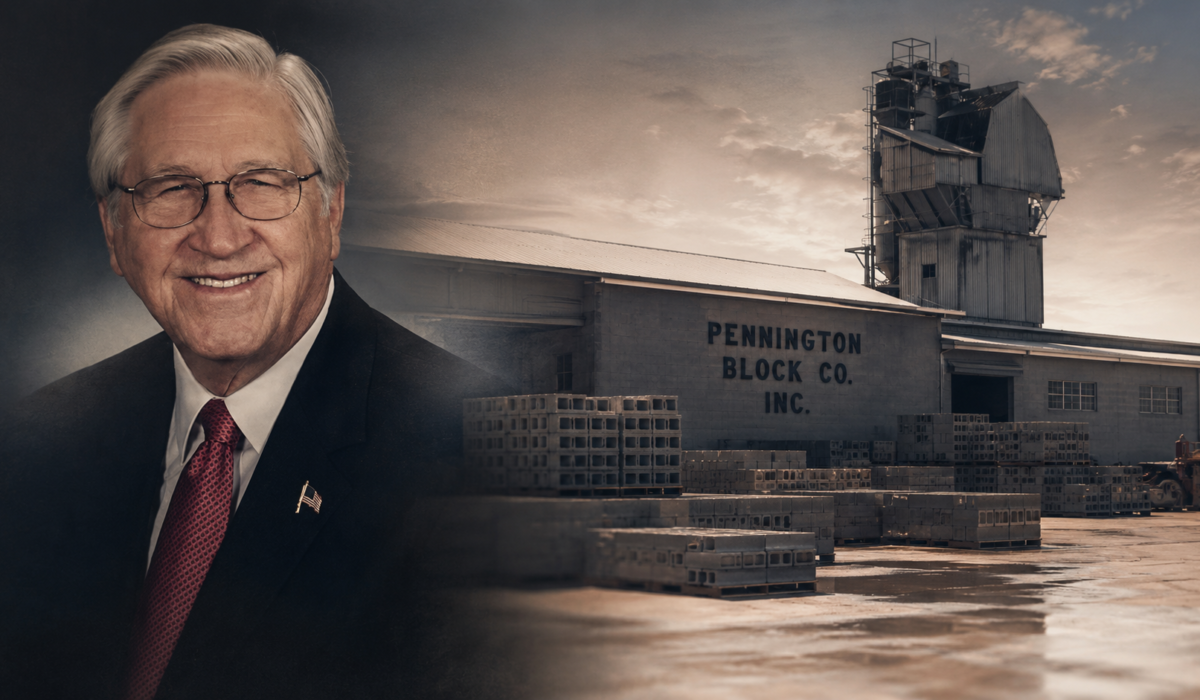
There was a time when a man’s name on the side of a business meant more than marketing.
It meant he stood behind the work.
For Charles “Charlie” Pennington, that name was Pennington Block. For Corbin, it was more than a block company. It was a local business built by a man who came from a large family, served his country, learned a trade, and spent decades making something people could use.
For me, it was my grandfather’s business.
And the older I get, the more I understand what that means.
Pennington Block was not built in the era of websites, dashboards, social media posts, automated systems, polished decks, or personal brands. It was built in an era of trucks, dust, concrete, handshakes, long days, and reputation. The product was simple in one sense and unforgiving in another.
Concrete block either holds weight or it does not.
There is no clever way around that.
That is what makes the story worth remembering now.
My grandfather was one of twelve children. Seven brothers. Four sisters. A family that large teaches lessons before a person ever walks into a job. It teaches patience, toughness, responsibility, and the reality that life does not bend around one person’s comfort.
Then came war.
He served in the Army Medical Corps during World War II. He became a Staff Sergeant. He managed field hospitals and drove an ambulance through Europe. His brothers who were old enough to serve also served.
It is easy today to say those words quickly and move on. We probably should not.
A whole family sending sons into war is not a small detail. It says something about the time. It says something about the family. It says something about the men who came home and were expected to keep moving.
Charlie Pennington did keep moving.
After the war, he became a mason. He built homes and businesses across the area. Then he founded Pennington Block Co. in Corbin. The company began in a barn on Scuffletown Road before later moving to South Main Street.
That beginning matters.
A barn on Scuffletown Road does not sound like a polished launch. It sounds like work. It sounds like a first version. It sounds like someone starting with what he had and building toward what the business could become.
That is how many real businesses used to begin.
No announcement campaign. No “coming soon” graphic. No strategy language. No brand rollout.
Just a man, a trade, a product, and enough belief to start.
Pennington Block grew into a business people knew. Customers came back. Employees showed up. Trucks moved product. The name became familiar because the work became familiar.
That kind of reputation is not built by saying the right things once.
It is built slowly.
Load by load.
Job by job.
Order by order.
Conversation by conversation.
And that is where the difference between my grandfather’s business era and today becomes hard to ignore.
Today, it is easier than ever to look like you are building something.
A person can create a logo in minutes. Launch a website in a day. Write a polished announcement before the idea has been tested. Build a presentation that makes a half-formed concept look complete. Fill a calendar with meetings and still not produce much that anyone can actually lean on.
That is the part people do not like to say.
Modern work can hide.
Bad decisions can hide in meetings. Broken processes can hide in email chains. Weak ideas can hide behind buzzwords. A person can appear busy, aligned, strategic, collaborative, and forward-thinking without building anything that truly holds weight.
My grandfather’s work did not have that option.
If the block was bad, people knew.
If the order was wrong, people knew.
If the truck was late, people knew.
If his word did not hold, people knew.
And they knew his name.
That is the burden and beauty of putting your family name on a business in a place like Corbin. There is no clean separation between the company and the man. The name on the sign is the same name people use when they see you around town. It is the same name your family carries. It is attached to the product, the promise, the mistake, and the fix.
That is not branding.
That is accountability.
I knew him as Papaw. I did not know him as an obituary or a business profile. I knew the man before I understood the full weight of the work. I knew Pennington Block before I understood what it takes to build a company and keep it going.
Age changes that.
You begin to understand that a business does not last because of one good week or one good year. It lasts because someone keeps showing up when it is hard, when it is boring, when it is heavy, when nobody is applauding, and when the problems still have to be solved.
My grandfather remained active in the business until he was nearly 90 years old.
That says a lot.
It says the business was not just an occupation. It was part of his identity. Part of his rhythm. Part of his connection to people and place.
Not everyone understands that kind of commitment now.
We live in a faster world. That is not all bad. In many ways, the tools today are remarkable. A person can build things from a laptop that would have required a full team years ago. Reports, websites, digital tools, customer presentations, strategy documents, dashboards, and articles can all be created faster than any previous generation could have imagined.
That speed is powerful.
It is also dangerous.
Because when it becomes easier to create, it also becomes easier to lower the standard.
More output does not always mean more value.
More polish does not always mean more substance.
More visibility does not always mean more credibility.
That is where Pennington Block still feels relevant to me.
It reminds me that usefulness matters more than appearance. It reminds me that the work should be strong enough to stand after the conversation ends. It reminds me that reputation is built through repeated experience, not announcement.
My work does not look like my grandfather’s work.
I do not make concrete block. I do not run a yard. I do not load trucks. I do not build homes with mortar, labor, and tools.
I work in a different world. Customers, strategy, data, relationships, reports, presentations, writing, digital tools, and ideas. The materials are different. The pace is different. The expectations are different.
But the question should not be different.
Will it hold?
Will the report hold when someone has to make a decision from it?
Will the strategy hold when a customer pushes back?
Will the relationship hold when something goes wrong?
Will the words hold when someone reads them and knows whether they are real?
Will the work still matter when the polish wears off?
That is the standard Pennington Block leaves behind for me.
It is not nostalgia. Not really. It is not pretending every old way was better or every new way is weaker. That would be too easy, and it would not be true.
My grandfather’s era had its own problems. It was harder, heavier, more physical, and less forgiving. But it did have a clarity that feels rare now.
The work had to prove itself.
The name had to stand behind it.
The reputation had to be earned.
Those things are still worth carrying forward.
I did not inherit Pennington Block. I did not take over the business. I am not walking into South Main Street every morning to check production or talk to customers.
But I did inherit the name.
And names are not light things when you care about them.
A name can be a gift. It can also be a responsibility.
That is what Pennington Block has become to me now. A reminder that if I am going to build something, it needs to matter. If I am going to put my name on something, I should not treat that casually. If the work is going to carry the name, then the work should carry some weight.
My grandfather built with concrete, block, trucks, dust, labor, and grit.
I build with different materials.
Words. Relationships. Ideas. Strategy. Tools. Customer work. Whatever I can use to make something clearer, stronger, or better than it was before.
Different era.
Different materials.
Same responsibility.
If your name is attached to it, it better mean something.